

[Polish version below]
Note Painting is not, for me, a “new painting style.” Style is usually associated with appearance: colour, composition, a type of line, something immediately visible. In NP, what matters more is something that comes earlier: the moment when the image is not yet an image on the wall, but already exists as notation.
An image can be hidden in signs. It can be written on a stave. It can wait to be performed. It may also never be performed at all and still remain a painterly composition.
This shifts the question of painting. We no longer ask only: what does the image look like? We ask instead: where does the image begin? Does it begin on the canvas, or earlier — in a decision, a rule, a sign, a sequence?
This is why NP can be placed in relation to contemporary theories of painting. Not as an illustration of those theories. Not as an example that has to be fitted into them. Rather, as an independent practice that, after many years, meets similar questions.
Rosalind Krauss wrote about the post-medium condition, a situation in which the medium can no longer be reduced to one material or one technique. For NP, what matters is not the term itself, but the shift it suggests: the medium of an image does not have to be only canvas, paint, or surface. It can also be a system of signs, rules, and possible performance.
NP does not invalidate the image. It asks what the image is actually made of. Paint? Format? Surface? Or also instructions, relations between signs, and the order of operations?
Yve-Alain Bois wrote about painting as a model. This idea feels close to NP because it allows us to move away from treating the image only as a finished surface. An image can be a model of thought. It can show how we organise relations, how we divide space, how we move from decision to form. This can also be extended into a question about the very process of modelling an image.
In NP, notation is not an addition to the image. It is the place where the image is thought through. It also touches a philosophical question: what is thought, and can an image be “thought” before divisions, directions, colours, lines, and priorities appear? Is the performed image one possible form of this mental notation?
David Joselit wrote about painting that does not end with itself, but operates through relations, contexts, and networks. In NP, this problem appears differently, but very clearly. The image does not end at its own edge, because beside it there is a score. There is notation. There is the possibility of another performance and another interpretation — and each of these performances can be an original in relation to the notation.
Then the question of the original becomes less obvious. Where is the actual image? In the performed work? In the code? In the rule? In the relation between them?
There is no need to answer too quickly. Perhaps this ambiguity is precisely what matters.
The beginnings of NP go back, in my case, to the late 1980s. From 1992 onward, I began developing the system more consciously, while studying in the drawing studio of Jarosław Kozłowski. For this reason, I do not think of NP as something that emerged under the influence of later theories of post-medium or network painting. I see it the other way around: NP developed along its own path, and only later did it become clear that it touched on questions that also became important in art theory.
This is important to me.
It is not about adding NP to a fashionable vocabulary of contemporary discourse. It is about showing that an image can exist in another state of matter. Not only as a surface, but also as information, notation, procedure, and possibility.
An image can be visible.
But it can also be written first as a system of rules that contains within it a trace of the environment in which it was created, as well as the feelings of the artist.
And only then wait for its performance.
Tom Lietzau
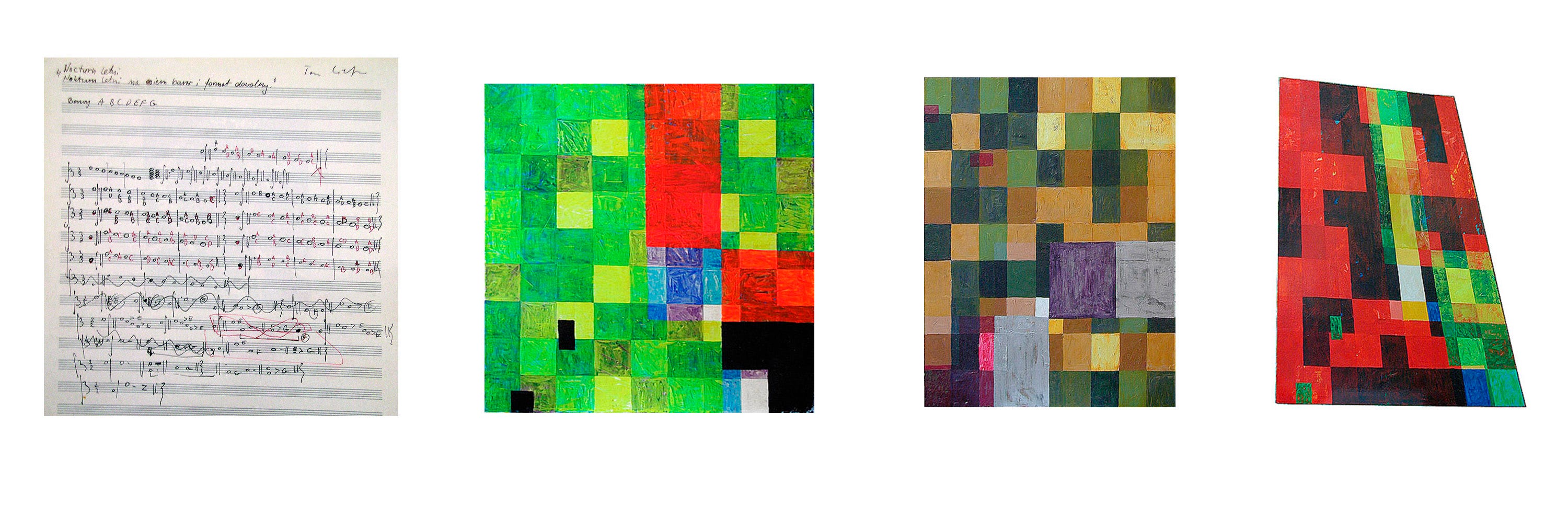
Note Paintig works aroud 1996
Notes
Rosalind Krauss, A Voyage on the North Sea: Art in the Age of the Post-Medium Condition, Thames & Hudson, 2000. The book develops the problem of the “post-medium condition,” a situation in which the medium can no longer be reduced to one material or technique.
Yve-Alain Bois, Painting as Model, MIT Press, 1990/1993. What matters to me here is not an academic application of theory, but the idea that painting can operate as a model of conceptual work.
David Joselit, “Painting Beside Itself,” October, no. 130, 2009. The text concerns painting that functions not only as a closed object, but also through relations, circulation, exhibition, and context.
Jarosław Kozłowski — a conceptual artist and educator associated with the art academy in Poznań. More: Culture.pl.
Note Painting — an artistic practice developed by Tom Lietzau. Its beginnings go back to the late 1980s; the system has been developed more consciously since 1992. More: tomlietzau.com/note-painting.
In my earlier texts, I described NP as an image coded on the stave, which can be performed, but can also remain only as notation — a painterly composition.
Polish version below
Obraz zapisany przed obrazem
O obrazie, który może istnieć najpierw jako zapis, procedura i możliwość wykonania
Note Painting nie jest dla mnie „nowym stylem malarskim”. Styl kojarzy się z wyglądem: z kolorem, kompozycją, rodzajem linii, z tym, co od razu widać. W NP ważniejsze jest coś wcześniejszego: moment, w którym obraz jeszcze nie jest obrazem na ścianie, ale już istnieje jako zapis.
Obraz może być ukryty w znakach. Może być rozpisany na pięciolinii. Może czekać na wykonanie. Może też nigdy nie zostać wykonany i nadal pozostać utworem malarskim.
To przesuwa pytanie o malarstwo. Nie pytamy już tylko: jak obraz wygląda? Pytamy raczej: gdzie obraz się zaczyna? Czy zaczyna się na płótnie, czy wcześniej — w decyzji, regule, znaku, kolejności?
Właśnie dlatego NP można zestawić ze współczesnymi teoriami malarstwa. Nie jako ilustrację tych teorii. Nie jako przykład, który trzeba do nich dopasować. Raczej jako osobną praktykę, która po latach spotyka się z podobnymi pytaniami.
Rosalind Krauss pisała o sytuacji post-medium, w której medium nie daje się już sprowadzić do jednego materiału albo jednej techniki. Dla NP ważny jest nie sam termin, ale przesunięcie: medium obrazu nie musi być wyłącznie płótnem, farbą albo powierzchnią. Może być także systemem znaków, reguł i możliwości wykonania.
NP nie unieważnia obrazu. Ono pyta, z czego obraz właściwie jest zbudowany. Z farby? Z formatu? Z powierzchni? A może także z instrukcji, z relacji między znakami, z kolejności działań?
Yve-Alain Bois pisał o malarstwie jako modelu. To sformułowanie jest mi bliskie, bo pozwala odejść od traktowania obrazu wyłącznie jako gotowej powierzchni. Obraz może być modelem myślenia. Może pokazywać, jak porządkujemy relacje, jak dzielimy przestrzeń, jak przechodzimy od decyzji do formy. Można to rozszerzyć i zapytać także o sam proces modelowania obrazu.
W NP zapis nie jest dodatkiem do obrazu. Jest miejscem, w którym obraz zostaje pomyślany. Dotyka też filozoficznego pytania: czym jest myśl i czy można „pomyśleć” obraz, zanim pojawią się podziały, kierunki, kolory, linie i priorytety? Czy wykonany obraz jest jedną z możliwych postaci tego myślowego zapisu?
David Joselit pisał o malarstwie, które nie kończy się na sobie samym, lecz działa przez relacje, konteksty i sieci. W NP ten problem pojawia się inaczej, ale bardzo wyraźnie. Obraz nie kończy się na własnej krawędzi, ponieważ obok niego istnieje partytura. Istnieje zapis. Istnieje możliwość kolejnego wykonania i kolejnej interpretacji — i każde z tych wykonań może być oryginałem w relacji do zapisu.
Wtedy pytanie o oryginał robi się mniej oczywiste. Gdzie jest właściwy obraz? W wykonaniu? W kodzie? W regule? W relacji między nimi?
Nie trzeba odpowiadać zbyt szybko. Być może właśnie ta niejednoznaczność jest ważna.
Początki NP sięgają u mnie końca lat 80. Od 1992 roku zacząłem rozwijać system bardziej świadomie, na studiach w pracowni rysunku u Jarosława Kozłowskiego. Dlatego nie myślę o NP jako o czymś, co powstało pod wpływem późniejszych teorii post-medium czy network painting. Raczej widzę to odwrotnie: NP rozwijało się własną drogą, a dopiero później okazało się, że dotyka pytań, które stały się ważne również w teorii sztuki.
To dla mnie istotne.
Nie chodzi o dopisanie NP do modnego słownika współczesnego dyskursu. Chodzi o pokazanie, że obraz może istnieć w innym stanie skupienia. Nie tylko jako powierzchnia, ale także jako informacja, zapis, procedura i możliwość.
Obraz może być widzialny.
Ale może też być najpierw zapisany jako system reguł, który zawiera w sobie ślad otoczenia, w którym powstał, oraz odczucia twórcy.
I dopiero wtedy czekać na swoje wykonanie.
Tom Lietzau
Przypisy
Rosalind Krauss, A Voyage on the North Sea: Art in the Age of the Post-Medium Condition, Thames & Hudson, 2000. Książka rozwija problem „post-medium condition”, czyli sytuacji, w której medium nie daje się już sprowadzić do jednego materiału lub techniki.
Yve-Alain Bois, Painting as Model, MIT Press, 1990/1993. W tym kontekście ważne jest dla mnie nie akademickie zastosowanie teorii, lecz myśl, że malarstwo może działać jako model pracy pojęciowej.
David Joselit, „Painting Beside Itself”, October, nr 130, 2009. Tekst dotyczy malarstwa, które funkcjonuje nie tylko jako zamknięty obiekt, ale także przez relacje, obieg, ekspozycję i kontekst.
Jarosław Kozłowski — artysta konceptualny i pedagog związany z poznańską uczelnią artystyczną. Więcej: Culture.pl.
Note Painting — autorska praktyka Tom Lietzau. Początki: koniec lat 80.; świadome rozwijanie systemu od 1992 roku. Więcej: tomlietzau.com/note-painting.
W moich wcześniejszych tekstach NP opisywałem jako obraz kodowany na pięciolinii, który może zostać wykonany, ale może też pozostać wyłącznie zapisem — utworem malarskim.