

[Polish version below]
Look around. Everything wants your beautiful eyes. Images glow with colour, pulse, swell to the size of buildings like iridescent bubbles, colours pour down walls. Old monochrome photographs, scratched and damaged, recover their colour; dead faces begin to move with smiles that were never there; nonexistent cities rise in seconds; algorithms dream; museums turn into spectacles; and millions of images, freed from the screen, canvas, place, matter, and sometimes even the author, race through the world at the speed of light, scattered in every direction, only to end their journey in the same small place — focused on the retina.
Duchamp had a name for this a century ago: retinal art.
He disliked art that ends where the eye begins. Art serving colour, form, “taste” and the pleasure of looking.
Duchamp did not discover the mind for art. It had been there all along. Several centuries earlier, Leonardo had regarded painting as something close to philosophy — a way of knowing the world. Duchamp suspected instead that somewhere along the way art had forgotten this and settled far too comfortably on the retina.
So he did something almost insolent.
He did nothing.
He chose a urinal.
He did not sculpt it. He did not improve it. He did not make it more beautiful. He shifted only one thing: the decision.
The object remained the same, but art did not.
Suddenly, a work could exist not only on a wall or in space, but also in a choice, an idea, a context. A few decades later, the Conceptual artists would go further. A work could become a sentence, an instruction, a definition, a number, a system. Sometimes something so visually unappealing that it was as if someone had deliberately switched off the light. The retina was disconnected. The child no longer saw only coloured pieces of glass, but had to wonder what it was actually looking at. Glass or diamonds? The iridescent bubble burst. The mind was instructed to switch on.
The revolution succeeded.
It entered museums. Art history. Textbooks.
It won.
So why does everything look as though it lost?
A century later, the world is drowning in images more saturated, dreamlike and dazzling than Duchamp could have imagined. The image no longer waits for me to approach it. It finds me. On my phone. In the street. In bed. It does not ask to be understood. It greedily demands a second of my eye, an eye slowly ceasing to respond to yet another coloured signal.
We can blame advertising, television, the art industry. Art galleries and shopping malls, fairs, media, marketing. The whole machine that may have discovered long ago that coloured pieces of glass are easier to sell than ideas. And at the same time it sells virtual dreams on ever more pieces of glass. Image begins to produce image.
We might even suspect that charlatans and conjurers of every kind have learned to operate our retinas better than artists have.
But perhaps that is too easy.
Perhaps this is exactly what we want?
Perhaps humanity does not need another idea, instruction or colourless sketch. Perhaps it does not want to wonder whether it perceives reality or only its ephemeral reflection in the shadows on the wall of the cave. Perhaps it wants images that are colourful, dreamlike, impossible — images that do not knock politely at the door of reason, but enter through the eye and stir the nervous system before we have time to think.
Perhaps Duchamp did not lose to the art industry. It still quotes him here and there, but only like an echo, a box ticked in an art-history textbook. A bridge across which an endless procession of retinal products of the human imagination marches into galleries.
Perhaps he lost to the human being?
Unable to contemplate their own thoughts.
Or perhaps there is no need to choose at all.
Eye or mind. Image or idea. Pleasure or thought.
Because an image does not end at the retina.
That is where its journey begins.
And that is the journey worth following now.
Next: Part 2 — When the Idea Became the Work. Coming soon.
Tom Lietzau
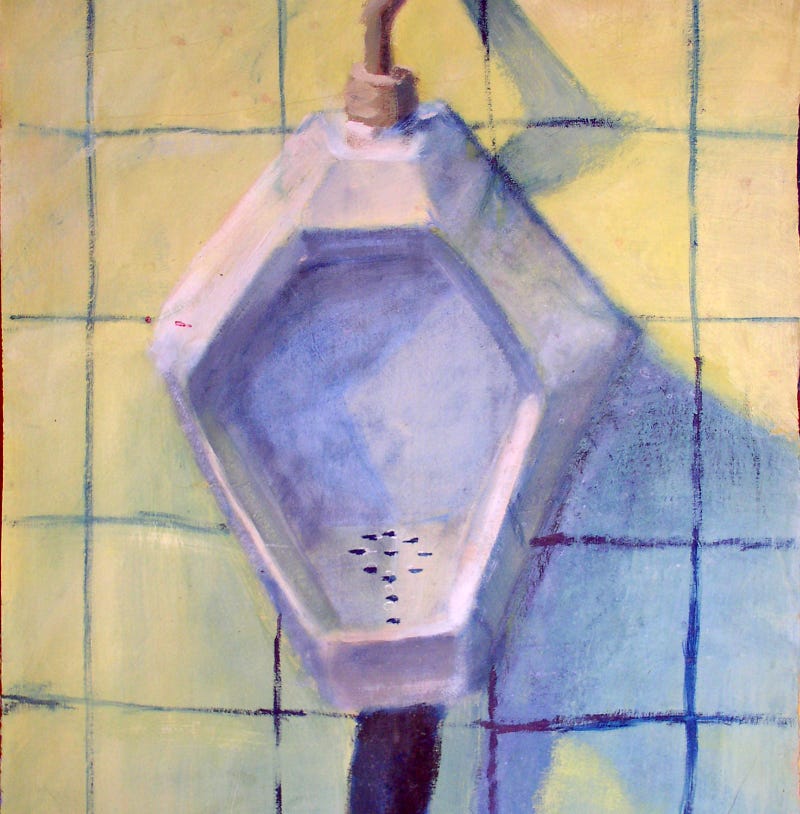
Tom Lietzau - Fountain 1986
Polish version
Siatkówka oka wygrała
Duchamp i rewolucja, która (być może) przegrała · Część 1 cyklu „Od sztuki siatkówkowej do sztuki struktur”
Rozejrzyj się. Wszystko chce twoich pięknych oczu. Obrazy świecą kolorem, pulsują, rosną do rozmiarów budynków jak tęczowe bańki, barwy spływają po ścianach. Stare, monochromatyczne, porysowane fotografie odzyskują kolor, martwe twarze zaczynają się poruszać z uśmiechem, którego nigdy nie było, nieistniejące miasta wyrastają w kilka sekund, algorytmy śnią, muzea zamieniają się w spektakle, a miliony obrazów, uwolnione od ekranu, płótna, miejsca, materii, a czasem nawet autora, pędzą przez świat z prędkością światła, rozszczepione we wszystkich kierunkach, żeby zakończyć podróż w tym samym miejscu — skupione na siatkówce oka.
Duchamp miał na to określenie już sto lat temu: retinal art, czyli „sztuka siatkówkowa”.
Nie podobała mu się sztuka, która kończy się tam, gdzie zaczyna się oko. Serwuje kolor, formę, „smak” dla przyjemności patrzenia.
Duchamp nie odkrył dla sztuki umysłu. Ten był tam od dawna. Leonardo kilka stuleci wcześniej widział w malarstwie niemal filozofię — sposób poznawania świata. Duchamp podejrzewał raczej, że gdzieś po drodze sztuka o tym zapomniała i zbyt wygodnie rozsiadła się na siatkówce oka.
Więc zrobił coś prawie bezczelnego.
Nic nie zrobił.
Wybrał pisuar.
Nie wyrzeźbił go. Nie poprawił. Nie uczynił piękniejszym. Przesunął tylko jedną rzecz: decyzję.
Przedmiot pozostał ten sam, ale sztuka już nie.
Nagle okazało się, że dzieło może znajdować się nie na ścianie czy w przestrzeni, lecz również w wyborze, idei, kontekście. Kilkadziesiąt lat później konceptualiści pójdą dalej. Dziełem stanie się zdanie, instrukcja, definicja, liczba, system. Czasem coś tak nieatrakcyjnego dla oka, jakby ktoś celowo zgasił światło. Siatkówka oka została odłączona. Dziecko nie widzi już tylko kolorowych szkiełek, lecz musi zastanowić się, na co właściwie patrzy. Co widzi? Szkiełka czy diamenty? Tęczowa bańka pękła. Zalecono włączyć umysł.
Rewolucja się udała.
Weszła do muzeów. Do historii sztuki. Do podręczników.
Wygrała.
Dlaczego więc wszystko wygląda tak, jakby przegrała?
Sto lat później świat tonie w obrazach bardziej nasyconych kolorem, onirycznych i olśniewających, niż Duchamp mógł sobie wyobrazić. Obraz nie czeka już, aż do niego podejdę. Sam mnie znajduje. W telefonie. Na ulicy. W łóżku. Nie prosi, żebym go zrozumiał. Łapczywie domaga się choćby sekundy mojego oka, które powoli przestaje reagować na kolejny barwny sygnał.
Można obwinić reklamę, telewizję, przemysł sztuki. Galerie sztuki i galerie handlowe, targi, media, marketing. Całą machinę, która być może dawno odkryła, że kolorowe szkiełka sprzedają się łatwiej niż idee. A przy okazji sprzedaje wirtualne marzenia na kolejnych szklanych szkiełkach. Obraz zaczyna produkować obraz.
Można nawet podejrzewać, że hochsztaplerzy i kuglarze przeróżnej maści nauczyli się obsługiwać naszą siatkówkę lepiej niż artyści.
Ale może to za łatwe.
Może właśnie tego chcemy?
Może ludzkość nie potrzebuje kolejnej idei, instrukcji i bezbarwnego szkicu. Nie chce zastanawiać się, czy postrzega rzeczywistość, czy tylko jej efemeryczne odbicie cieni na ścianie jaskini. Może chce obrazów kolorowych, onirycznych, niemożliwych — takich, które nie pukają do rozumu, tylko wpadają przez oko i poruszają układ nerwowy, zanim zdążymy pomyśleć.
Może Duchamp nie przegrał z przemysłem sztuki. Ten stale gdzieś go cytuje, ale już tylko jak echo, odhaczony punkt w podręczniku historii sztuki. Pomost, po którym do galerii ciągnie niekończący się pochód siatkówkowych wytworów ludzkiej wyobraźni.
Może przegrał z człowiekiem?
Niezdolnym do kontemplacji własnych myśli.
A może wcale nie trzeba wybierać.
Oko albo umysł. Obraz albo idea. Przyjemność albo myślenie.
Bo obraz nie kończy się na siatkówce.
Tam dopiero zaczyna swoją drogę.
I właśnie tę drogę warto teraz prześledzić.
Dalej: część 2 — Kiedy idea stała się dziełem. Wkrótce.